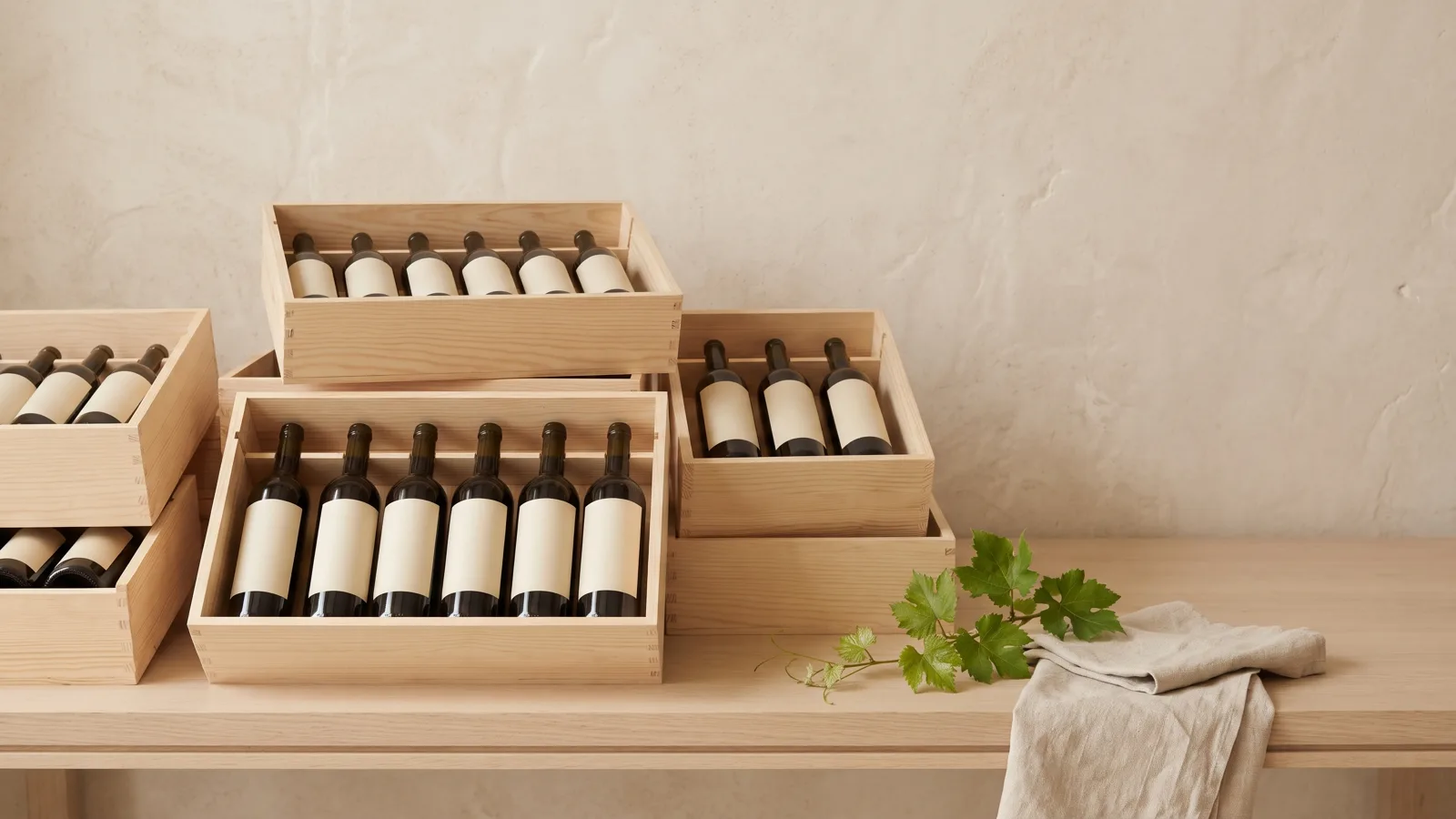
Since 12 August 2026 the EU Packaging Regulation (PPWR) asks for a technical file and an EU declaration of conformity for every packaging type placed on the market. When the winery or Champagne house is a micro-enterprise and its packaging supplier is in the EU, Article 15(12) makes the supplier the manufacturer: the crate, case or gift-box maker draws up the file and signs the declaration. Today that mostly means evidence on heavy metals for each component (wood, inks, varnish, glue, nails, hinges) and a declaration per type. Recyclability does not apply to lightweight wooden sales packaging, and wines with a protected designation are exempt from the minimisation criteria. EUR-Lex
Why the declaration lands on the packaging maker
Under the PPWR the manufacturer is normally whoever has packaging made under its own name or trademark, so a winery ordering crates with its logo would be the manufacturer of those crates. Article 15(12) changes that for small customers: where that brand owner is a micro-enterprise and its packaging supplier is established in the Union, the supplier is considered the manufacturer for the obligations of Article 15. EUR-Lex
A micro-enterprise employs fewer than 10 people and has a turnover or balance sheet of €2 million or less. Most French wine estates and many Champagne growers fit that definition. That is why crate makers are receiving requests for a "PPWR declaration" from their winery customers: the obligation is theirs for those customers. EUR-Lex
| Your customer | Your PPWR role | What you do |
|---|---|---|
| Micro-enterprise estate, crates with its name or logo | Manufacturer (Art. 15(12)) | Technical file and declaration of conformity per packaging type |
| Larger house or cooperative, crates with its name or logo | Supplier | Give it the information and documents it needs (Art. 16) |
| Anyone, crates from your own catalogue under your name | Manufacturer | Technical file and declaration per packaging type |
What applies to wine packaging today
The PPWR has applied since 12 August 2026 in every member state. For wooden crates, cardboard cases and gift boxes, these are the requirements that apply now and later: EUR-Lex
| Requirement | From | For wine packaging |
|---|---|---|
| Heavy metals: lead, cadmium, mercury and hexavalent chromium together at most 100 mg/kg (Art. 5(4)) | 12 August 2026 | Evidence per component: wood, screen-printing inks, varnish, glue, nails, hinges, clasps |
| PFAS limits (Art. 5(5)) | 12 August 2026 | Food-contact packaging only, so not crates around bottles; trays or liners that touch food are concerned |
| Technical file and EU declaration of conformity (Art. 15, Annex VII and VIII) | 12 August 2026 | One declaration per packaging type, kept 5 years (single-use) or 10 years (reusable) |
| Harmonised sorting label (Art. 12) | 12 August 2028 at the earliest | Applies when the implementing acts are adopted |
| Recyclability grades (Art. 6) | 2030 at the earliest | Not for sales packaging made of lightweight wood or cork (Art. 6(11)(g)); applies to cardboard cases and gift boxes |
| Minimisation (Art. 10) | 1 January 2030 | Products with a protected geographical indication, wine included, are exempt from the performance criteria (Art. 10(2)(b)) |
So for a pine or poplar wine crate, today's work is the substance evidence and the paperwork. For cardboard cases and gift boxes, plan for the recyclability grades from 2030.
The technical file: what it holds
The conformity route is internal production control, module A of Annex VII. There is no notified body and no certificate. For each packaging type the file holds:
- a general description of the packaging and its intended use;
- the design and manufacturing drawings, and the materials of each component;
- the standards or specifications applied;
- a qualitative description of how the recyclability, minimisation and reuse assessments were made, where they apply;
- test reports, and an analysis of the risks of non-conformity.
The declaration of conformity (Annex VIII) carries a unique identification number, the manufacturer's name and address, a description that allows traceability, the legislation and standards applied, and the signature. It is issued under the manufacturer's sole responsibility.
What a packaging type means for a crate maker
One type is one design in one combination of materials. Crates for 1, 3, 6 and 12 bottles in the same pine with the same finish can share most of the evidence, but each is a type with its own declaration. Every custom design for a winery, a new print or a new varnish, adds a type or a new version.
That is where the work piles up: one customer is easy, two hundred estates with their own logo and finish are a register to keep.
Typical gaps we find
- No answer, customer by customer, to "is this winery a micro-enterprise?", so nobody knows whose declaration it is.
- Supplier statements on inks, varnish or glue that cite the old Packaging Directive or cover the material but not the finished component.
- No list of packaging types: the same crate sold in five finishes with one declaration.
- No version history when a design or a supplier changes, although Article 15(4) asks for a reassessment.
- Declarations kept by e-mail only, with nothing that survives the 5 or 10 years.
EPR in France for wine packaging
The PPWR does not replace French EPR. The estate or house that puts the packaged wine on the market declares the bottles, closures, cases and crates that reach households to its eco-organisme (Adelphe, Citeo or Léko). Packaging that ends with businesses falls under professional packaging EPR (EPRO) from 1 January 2027. A crate maker selling empty crates is usually not the EPR producer; the winery that packs and sells is. Sources (2)EUR-LexEUR-Lex — Regulation (EU) 2025/40 (PPWR) ADEMEADEME — professional packaging (EPRO) scheme page
A producer established outside France needs a French representative for its EPR since 10 July 2026. That is our core service: see our services.  Légifrance
How we help
We work with French packaging makers on two levels:
- Per packaging type: you send a complete file (description, drawings, materials and each supplier's statements), we check it and return the declaration and the technical file. €149 per type when you draft and we review, €290 per type when we draft from your file.
- Monthly support: we request and follow up the statements from your suppliers ourselves, keep your register of types and versions, and add your new custom designs as they come. On quote, from the number of types and suppliers.
Not sure where your range stands? The PPWR readiness check reviews up to 25 packaging items in 10 working days. The declaration service is on its own page. EUR-Lex
Frequently asked questions
Our winery customer asks us for a PPWR declaration. Do we have to provide it?
If the winery is a micro-enterprise (fewer than 10 people and €2 million or less turnover or balance sheet) and you are its packaging supplier in the EU, yes: Article 15(12) makes you the manufacturer of that packaging, so the declaration is yours to draw up and sign. For a larger customer you are its supplier and give it the information it needs under Article 16.
Do wooden wine crates need a recyclability grade?
No. Article 6(11)(g) excludes sales packaging made from lightweight wood, cork, textile, rubber, ceramic, porcelain or wax from the recyclability requirements of Article 6, apart from paragraph 8. Cardboard cases and gift boxes are not excluded. ADEME
Does the minimisation rule apply to Champagne gift boxes?
The performance criteria of Annex IV do not apply to packaging of products with a protected geographical indication under the wine and spirits rules (Article 10(2)(b)). Champagne and other AOC wines are protected designations.
Do we need a notified body or a laboratory certificate?
No notified body. The route is internal production control (Annex VII, module A): you document the assessment yourself. Test reports go in the file where they support the substance evidence.
How long must we keep the file?
Five years after the packaging is placed on the market for single-use packaging, ten years for reusable packaging.
Is one declaration enough for all our crates?
One per packaging type. A type is one design in one combination of materials; sizes and finishes that change the materials or components are separate types.

Razvan Toma is the founder of EPR France Rep, a France-established authorised representative (mandataire) for producers with no French establishment. He has worked in waste management and recycling since 2009, running circular economy programmes inside large B2B organisations in France for clients including Chanel, Microsoft, Decathlon, Pirelli, IKEA, Vinci, Capgemini and E.Leclerc.
Connect on LinkedIn →