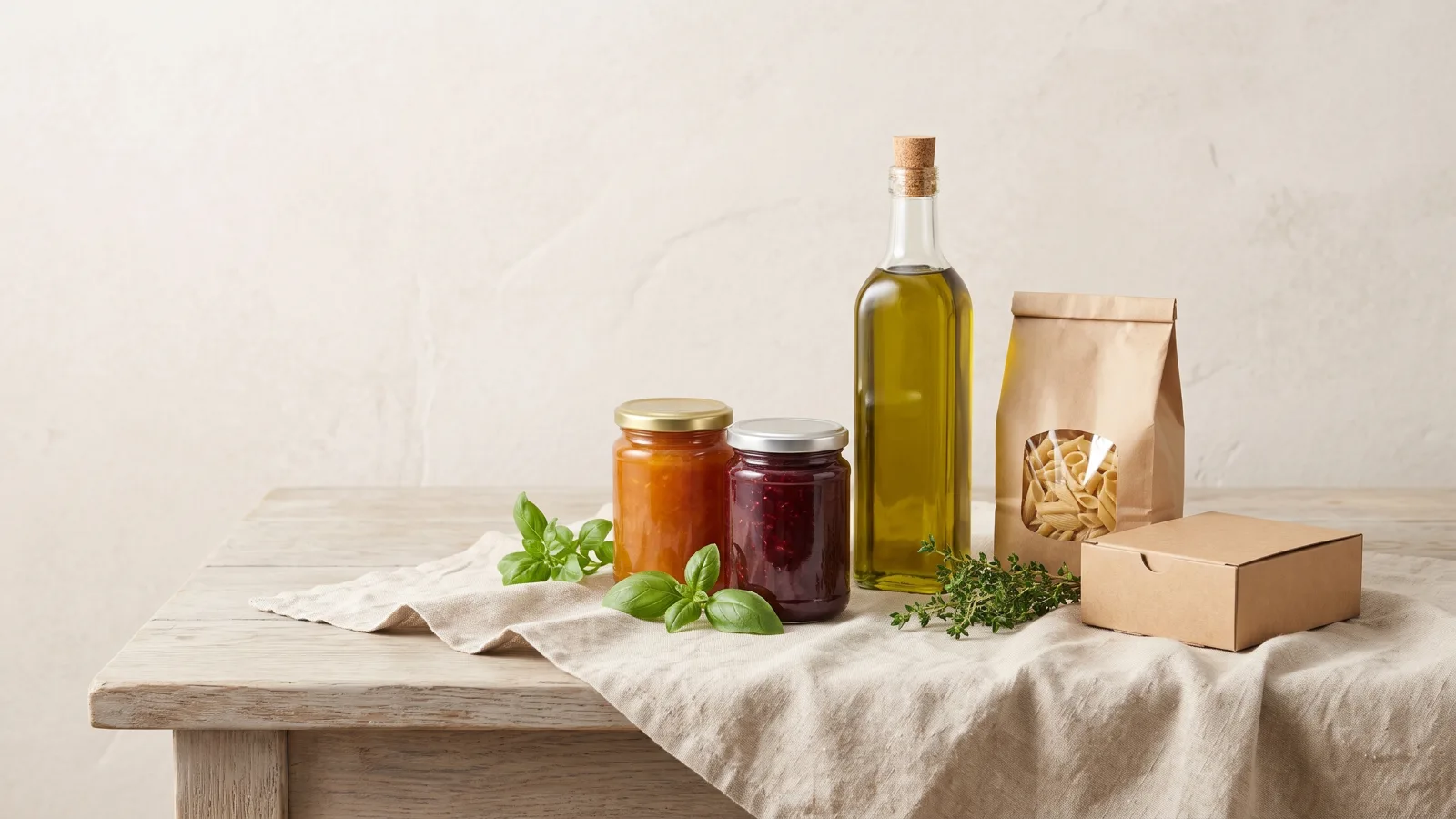
Food and drink have no product stream in France: their packaging does. Packs sold to consumers, at home or out of home, are household packaging (Citeo, Léko or Adelphe); packaging of goods sold to restaurants and other businesses is professional packaging (EPRO), fully in force from 1 January 2027. A brand that sells both ways needs both memberships and both IDUs. Since 10 July 2026 a food company with no establishment in France acts through a French representative.Sources (3) ADEMEADEME — Filière REP Emballages ménagers et papiers (EMPAP)ADEMEADEME — professional packaging (EPRO) scheme page
 LégifranceLégifrance — article L. 541-10-9-1 of the Environmental Code (full text)
Which French EPR streams apply to food and drink
French EPR finances the end of life of what a product leaves behind. For food that is the packaging and the printed paper around it: jars, bottles, cans, trays, films, cartons, leaflets and recipe cards ADEME. The household packaging stream covers packaging of products consumed by households, wherever they eat them, so a sandwich wrapper bought at a station is household packaging as much as a jar of jam bought in a supermarket. Packaging of goods used by businesses is a separate stream, professional packaging, which today covers the primary packaging of food used by restaurants and bars and from 1 January 2027 covers all professional packaging ADEME.
| What you place on the French market | Stream or rule | Eco-organismes | Who declares | Status | Source |
|---|---|---|---|---|---|
| Jars, bottles, cans, trays, films and cartons sold to consumers, in shops or online | Household packaging and printed paper | Citeo, Léko, Adelphe | The brand that packs or has the food packed; the importer of packaged food | In force | ADEME |
| Food eaten out of home: snacks, drinks and takeaway sold to consumers | Household packaging and printed paper | Citeo, Léko, Adelphe | The same producer: household packaging covers consumption out of home too ADEME | In force | ADEME |
| Primary packaging of food used by restaurants and bars, above the size thresholds | Professional packaging (EPRO) | Citeo Pro, Léko Pro, Twiice | The company that packs the food for the catering customer | In force | ADEME |
| Every other packaging of goods sold to businesses: catering formats, cartons, pallets, stretch film | Professional packaging (EPRO) | Citeo Pro, Léko Pro, Twiice | The company that packs the goods; from 2027 the producer of article 3(15) of the PPWR  EUR-Lex | From 1 January 2027 | ADEME |
| Leaflets, recipe cards, menus and catalogues | Household packaging and printed paper | Citeo, Léko, Adelphe | The company that issues them, free copies included | In force | ADEME |
| Coffee machines, blenders and other appliances sold under the food brand | Electrical and electronic equipment | ecosystem, Ecologic, Soren | The brand or importer of the appliance | In force | ADEME |
| The food and drink themselves | No EPR stream | — | No producer duty: French EPR covers their packaging and printed paper, not the food | In force | — |
| Each packaging type, food-contact packaging included: technical file and EU declaration of conformity | EU Packaging Regulation (PPWR) | — | The packaging manufacturer under the PPWR: usually the brand whose name is on the pack EUR-Lex | Since 12 August 2026 | EUR-Lex |
This table as data: JSON · CSV · CC BY 4.0, cite EPR France Rep
The line that decides most food companies' bill is the split between the first and the fourth rows. The same 5-litre tin of olive oil is household packaging when a family buys it in a shop and professional packaging when a restaurant buys it from a wholesaler. The test is who uses the product, not who you invoice: see household or professional packaging. Sources (2)ADEMEADEME — professional packaging (EPRO) scheme pageADEMEADEME — Filière REP Emballages ménagers et papiers (EMPAP)
Who the producer is
For packaging the producer is the business that packs its products, or has them packed, to place them on the market; the importer of packaged products; and, if neither can be found, whoever first places them on the French market ADEME. In practice:
- You sell to French consumers yourself, from your own shop, a marketplace or a subscription box: you are the producer of every pack and every shipping carton.
- You sell to a French importer or distributor that buys and resells: the importer of packaged products is usually the producer of the packaging it places on the French market. Agree it in writing and keep its IDU on file. ADEME
- You deliver direct to French supermarkets, restaurants or caterers: you place the goods on the French market yourself, so the packaging is yours: household for the consumer packs, professional for the catering formats.
- You pack under a retailer's own brand: the retailer that has the product packed under its name is generally the producer. Your shipping packaging to its warehouses can still be yours from 2027.
A worked example
An illustration, not a client: an olive oil producer based in Spain sells in France through its own online shop and Amazon.fr, and delivers direct to about forty French restaurants. In a year it ships 40,000 glass bottles of 50 cl, each about 400 g of glass with an aluminium cap, and 3,000 tins of 5 litres to the restaurants.
| Item | Stream | How it is declared |
|---|---|---|
| 40,000 glass bottles, about 16 tonnes | Household packaging | Kilograms by material: glass carries €0.02 per kg, so about €320 for the glass, plus the per-unit part of the tariff ADEME |
| 40,000 aluminium caps and labels | Household packaging | Aluminium €0.246 per kg, paper and board €0.255 per kg |
| E-commerce cartons and dividers | Household packaging | Paper and board €0.255 per kg |
| 3,000 tins of 5 litres for restaurants | Professional packaging | Steel by the tonne; the catering formats above the size thresholds are already in the stream, the rest joins on 1 January 2027 ADEME |
| Cartons and pallets to restaurants | Professional packaging, from 2027 | Paper and board from about €34 per tonne, wood from about €8 per tonne, depending on the eco-organisme ADEME |
Two streams, two memberships and two IDUs. The bill is small; the work is not. Each SKU needs its weight per material and component, and every order needs to be counted once in the right stream. Our EPR calculator gives a first figure from your own data.
The industry in France, in figures
Food and drink is France's largest manufacturing industry by sales, and the largest user of household packaging: almost every product reaches the consumer in a pack. ADEME
| Figure | Value | Year | What it measures | Source |
|---|---|---|---|---|
| Sales of the French food and beverage industries | €162bn | 2024 | Sales of food and beverage manufacturers, Agreste | Agreste: sales of the French |
| Food and drink companies in France | about 20,000 | 2025 | Companies counted by the industry federation | ANIA press release, Septembe |
| Household packaging handled by Citeo | 5.4 Mt | 2025 | All sectors, of which food and drink is the largest share |  Citeo annual report 2025 |
| Companies in contract with Citeo | 87,972 | 2025 | Household packaging and paper, all sectors | Citeo annual report 2025 |
PPWR: what changes for food packaging
The EU Packaging Regulation (Regulation (EU) 2025/40) has applied since 12 August 2026 EUR-Lex. Food is the sector it touches most, because so much of its packaging is in contact with the product:
- PFAS in food-contact packaging, now: Article 5(5) sets limits on per- and polyfluoroalkyl substances in packaging that comes into contact with food. Paper and board wrappers, greaseproof bags, moulded fibre trays and some coatings are the usual suspects. You need your supplier's evidence in the technical file.
- Heavy metals, now: lead, cadmium, mercury and hexavalent chromium together at most 100 mg/kg in each packaging component (Art. 5(4)).
- A technical file and an EU declaration of conformity per packaging type, now (Art. 15, Annexes VII and VIII). The manufacturer is whoever has the packaging made under its name or trademark, so usually the food brand. Where the brand is a micro-enterprise and its packaging supplier is in the EU, the supplier takes that role (Art. 15(12)).
- Harmonised sorting labels from 12 August 2028 at the earliest, then recyclability grades and packaging minimisation from 2030.
Wine has its own rules, including an exemption from minimisation for some protected wines: see the wine estates and merchants page. For everyone else we start with the PPWR readiness check on your current formats. EUR-Lex
Where the work piles up
- Pack specifications. A range of 80 SKUs can have 300 components: bottle, cap, label, sleeve, tray, film, carton. Each needs a weight and a material, and co-packers change them without telling you.
- Channel split. Consumer packs and catering formats go to different streams, and a wholesaler can sell the same format to both. The split must follow the end user.
- Two calendars. Household packaging is declared once a year on estimates; professional packaging has its own eco-organismes, rates and dates from 2027. Sources (2)ADEMEADEME — professional packaging (EPRO) scheme pageADEMEADEME — which producers the EPR schemes cover
- Food-contact evidence. PFAS and heavy-metal statements from every food-contact supplier, kept per packaging type, for the declaration of conformity.
- Marketplace numbers. Amazon.fr and Cdiscount ask for the household packaging IDU before your listings go live. Sources (2)ADEMEADEME — Filière REP Emballages ménagers et papiers (EMPAP)ADEMEADEME — all about the unique identifier (IDU)
What Managed EPR does for you
With Managed EPR our team does the data work all year and you approve the result. For this industry that means:
- building a packaging register per SKU (each component's weight and material) from your specifications and your co-packers;
- splitting your French sales between household and professional packaging by end user, channel by channel; ADEME
- running both calendars: the household declaration and, from 2027, the professional packaging declarations; ADEME
- collecting PFAS and heavy-metal statements from your food-contact suppliers and filing them per packaging type;
- checking that each marketplace holds your household packaging IDU. Sources (2)ADEMEADEME — Filière REP Emballages ménagers et papiers (EMPAP)ADEMEADEME — all about the unique identifier (IDU)
Every month we reconcile your French sales and list missing data; every quarter you get a forecast of your eco-contributions; before each declaration you approve the figures, and at year end you get the evidence pack behind each one. You keep your memberships and IDUs if you already have them: we take over from your declaration history under a written mandate.
If you are not established in France
Since 10 July 2026 a producer with no establishment in France must appoint a representative established in France by written mandate (article L. 541-10-9-1 of the Environmental Code) Légifrance. It applies to EU and non-EU companies alike and has no minimum volume. The representative joins the eco-organismes in your name, obtains your IDUs and files your declarations: that is our core service, see what we do.
What it costs
Three ways to work with us, depending on how much of the work you want to hand over.
| Service | What we do | Price |
|---|---|---|
| Representative, Standard | Mandate, membership, IDU and one declaration a year for household packaging and printed paper, up to 1 tonne a year per stream Sources (2)ADEMEADEME — Filière REP Emballages ménagers et papiers (EMPAP)ADEMEADEME — all about the unique identifier (IDU) | €190 a year per stream |
| Representative, Plus or Plus Pro | Up to three streams, up to 10 tonnes a year, with detailed reporting; Plus Pro when you also sell to businesses | €990 a year |
| Managed EPR | We run the data work, with a median saving of €1,071 a year in eco-contributions across our published clothing, footwear, electronics and furniture examples: monthly sales reconciliation, supplier follow-up, quarterly forecast, every declaration prepared for your approval, year-end evidence pack Sources (2)ADEMEADEME — Filière REP Textiles, linge, chaussures (TLC)ADEMEADEME — Filière REP Éléments d'ameublement (EA) | On quote, after a look at your data |
| PPWR | Readiness check of up to 25 packaging items; declaration of conformity and technical file per packaging type | €390 per company; €149 per type reviewed, €290 prepared by us |
Setup is €0. Eco-contributions are billed by the eco-organisme at its official rate and passed on with 0% markup. See pricing, Managed EPR and the PPWR readiness check. Sources (2)EUR-LexEUR-Lex — Regulation (EU) 2025/40 (PPWR)ADEMEADEME — which producers the EPR schemes cover
Frequently asked questions
Is food waste an EPR stream in France?
No. French EPR covers the packaging and printed paper around food, not the food itself.
We only sell to wholesalers. Which stream?
It depends on who ends up using the product: if consumers buy it in that format, household packaging; if businesses use it, professional packaging. If the wholesaler imports the goods, it is usually the producer. Sources (2)ADEMEADEME — professional packaging (EPRO) scheme pageADEMEADEME — Filière REP Emballages ménagers et papiers (EMPAP)
Are restaurant packs already in professional packaging?
Partly. The primary packaging of food used by restaurants and bars, above the size thresholds of the 2023 scope order, has been in the stream since 2023. All other professional packaging joins on 1 January 2027. ADEME
Which eco-organisme for household packaging?
Citeo, Léko or Adelphe, all approved until 31 December 2029. We compare them on your mix of materials. ADEME
Do food-contact packs need a PPWR declaration?
Yes. Every packaging type placed on the EU market needs a technical file and a declaration of conformity since 12 August 2026, and food-contact packaging must also meet the PFAS limits of Article 5(5).
Is a reusable crate or keg declared?
Reusable packaging is declared too, and in household packaging a reusable pack with a working reuse system gets a 100% reduction of its unit contribution. We check that your system qualifies. ADEME

Razvan Toma is the founder of EPR France Rep, a France-established authorised representative (mandataire) for producers with no French establishment. He has worked in waste management and recycling since 2009, running circular economy programmes inside large B2B organisations in France for clients including Chanel, Microsoft, Decathlon, Pirelli, IKEA, Vinci, Capgemini and E.Leclerc.
Connect on LinkedIn →