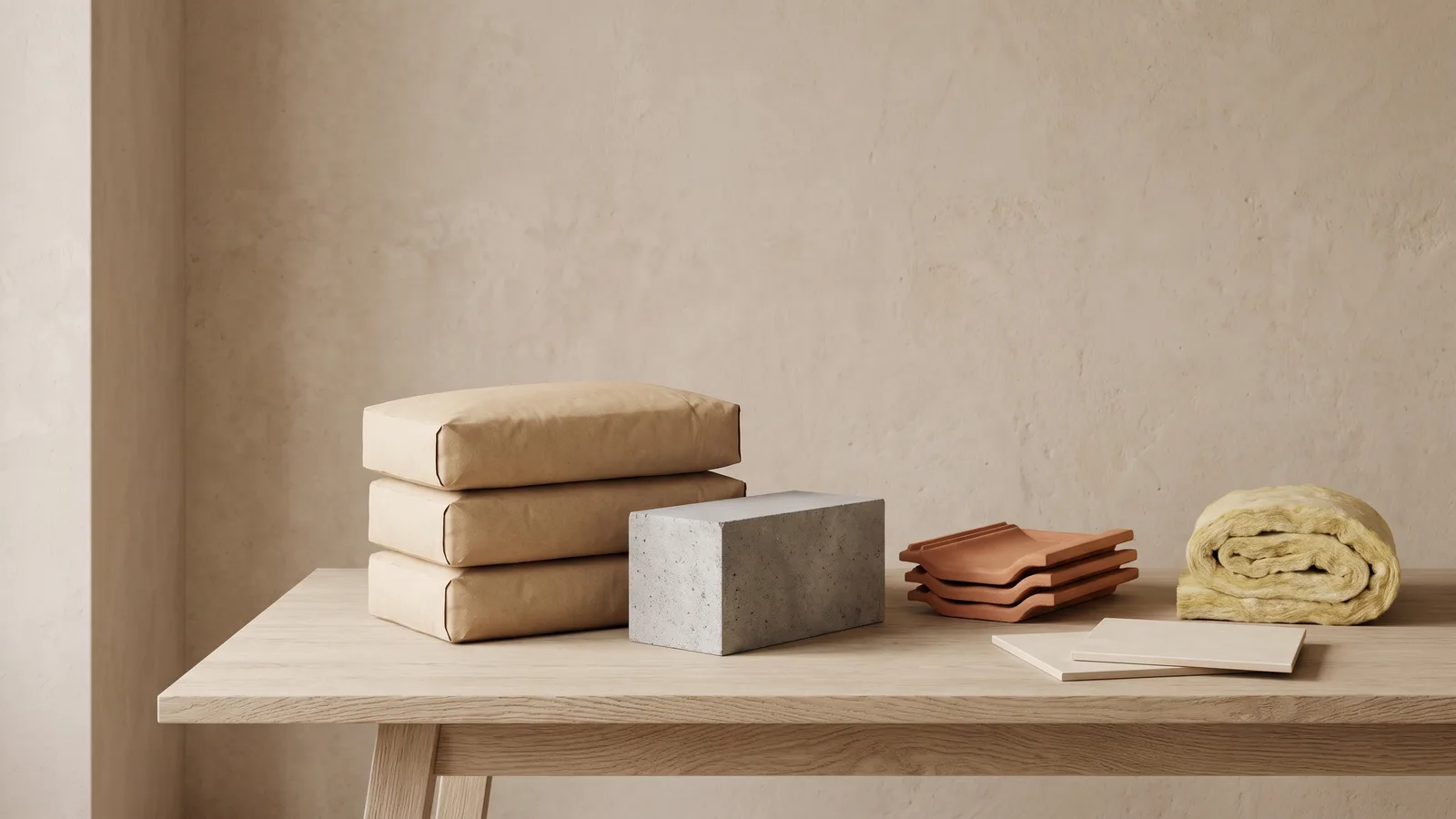
Building products and materials have had their own French EPR stream since 1 January 2023. Category 1, mineral products such as cement, concrete, mortars, bricks and tiles, goes to Ecominéro or Valobat; category 2, everything else, to Valobat, Ecomaison or Valdelia. A manufacturer outside France that sells to French distributors is not forced to join: its French buyer then pays as importer. Most join anyway, through a representative established in France, because French buyers prefer products that arrive with the eco-contribution already paid.Sources (3) ADEMEADEME — Filière REP PMCB : éco-organismes agréés, données
 Journal officielJournal officiel — Avis relatif au champ d'application de la filière REP PMCB, JO du 17 juin 2023 (NOR TREP2315866V)
 LégifranceLégifrance — article L. 541-10-9-1 of the Environmental Code (full text)
What the building products stream covers
Article R. 543-289 of the Environmental Code defines building products as products and materials, wall, floor and ceiling coverings included, intended to be permanently incorporated, installed or assembled in a building or used for its fittings on its plot, parking included, except products used only for the duration of the works Journal officiel. The test is the use, not the material. The 2023 scope notice splits the stream into two categories, and the category decides which eco-organismes can take you ADEME.
| What you place on the French market | Stream or rule | Eco-organismes | Who declares | Status | Source |
|---|---|---|---|---|---|
| Cement, concrete, mortars, lime, aggregates, stone, bricks, roof tiles, ceramics (category 1, mineral) | Building products and materials (PMCB) | Valobat, Ecominéro, Ecomaison, Valdelia | The maker if it joins; otherwise the French importer, distributor or contractor that buys abroad. Eco-organismes: Ecominéro or Valobat ADEME | In force | ADEME |
| Wood, metal, joinery and glazing, plaster, plastics, insulation, bitumen products (category 2) | Building products and materials (PMCB) | Valobat, Ecominéro, Ecomaison, Valdelia | The same rule. Eco-organismes: Valobat, Ecomaison or Valdelia Sources (2)ADEMEADEME — Filière REP Éléments d'ameublement (EA)ADEMEADEME — Filière REP PMCB : éco-organismes agréés, données | In force | ADEME |
| Mortars, renders, paints, adhesives and resins (family 2.c), with their bucket, sack or cartridge | Building products and materials (PMCB) | Valobat, Ecominéro, Ecomaison, Valdelia | Declared with the product: the container is part of it | In force | ADEME |
| Hazardous DIY chemicals: solvent paints, sealants, treatments Sources (2)ADEMEADEME — Filière REP Articles de bricolage et de jardin (ABJ)ADEMEADEME — Filière REP Produits chimiques (PCHIM) | Chemical products (DIY and household) | EcoDDS | The maker, importer or first seller of the product to end users | In force | ADEME |
| Sacks, pallets, shrink hoods, big bags and film delivered to builders' merchants and contractors | Professional packaging (EPRO) | Citeo Pro, Léko Pro, Twiice | The company that packs the goods, unless the building stream takes the container | From 1 January 2027 | ADEME |
| Sacks, buckets and cartons that reach consumers through DIY stores or online ADEME | Household packaging and printed paper | Citeo, Léko, Adelphe | The company that packs the goods, unless the building stream takes the container | In force | ADEME |
| Products used only during the works: formwork, scaffolding, site protection | No EPR stream | — | Outside the building products stream (article R. 543-289) | In force | — |
| Each packaging type: technical file and EU declaration of conformity | EU Packaging Regulation (PPWR) | — | The packaging manufacturer under the PPWR: usually the brand on the sack or bucket  EUR-Lex | Since 12 August 2026 | EUR-Lex |
This table as data: JSON · CSV · CC BY 4.0, cite EPR France Rep
Category 1 is mineral: concrete and mortar and their components (cement, aggregates, admixtures, precast and aerated concrete, mineral mortars), lime, stone, fired and raw clay, slate, asphalt, aggregates and ceramics such as tiles and sanitaryware. Category 2 is everything else: metal, wood, glazed joinery, plaster, plastics, bitumen products, glass and rock wool, and plant-based products such as linoleum, wood fibre or cork. Family 2.c, mortars, renders, paints, varnishes, resins and adhesives, is declared with its container. See categories 1 and 2 in full.
Who the producer is when you sell from abroad
Article R. 543-290 makes the producer whoever manufactures under its own name for use in French buildings, or whoever imports or first places the product on the French market. The scope notice names three importers: the French distributor or builders' merchant that buys abroad, the contractor that buys abroad to install on its French sites, and the end client of a French site. Each pays unless it can prove that the exporter contributed for the products concerned Journal officiel.
So the duty is real, but it can sit with your buyer. Most foreign manufacturers join anyway:
- Your buyers stop paying as importers. A product that arrives with the eco-contribution paid saves the distributor a declaration, an invoice and a risk, which makes your offer cheaper than an unregistered competitor's.
- You control the classification. The product line decides the rate; several importers each guessing your line is how the dearest rate ends up applied.
- One membership covers every French customer, and the eco-contribution appears on your invoices: Ecominéro's guide makes passing it on to the customer mandatory for the first placer on the market Ecominéro.
A manufacturer established outside France joins through a representative established in France (article L. 541-10-9-1, since 10 July 2026) Légifrance. See importer or manufacturer.
Valobat or Ecominéro: rates and rhythm
For category 1 the choice is between two eco-organismes, and it changes both the bill and the paperwork. Ecominéro takes a declaration every month, by 8-digit product code, with the December declaration adjusting the year; Valobat takes one a year and offers simplified regimes to small producers Sources (2)EcominéroEcominéro — Guide de la déclaration PMCB (juillet 2025), boîte à outils producteursValobatValobat — Adhésion, déclaration, facturation. On the 2026 rates, cement costs €10.26 a tonne at Ecominéro (€9.23 for CEM II Portland-composite cement) and €7.70 a tonne at Valobat; ready-mix concrete €3.02 or €2.40 a cubic metre; cement-based premix €2.52 or €3.94 a tonne Sources (2)EcominéroEcominéro — Barème à compter du 1er août 2026ValobatValobat — barèmes PMCB. No scheme is cheapest for everything, so we price your actual list before you join: see which eco-organisme.
A worked example: bagged cement
An illustration, not a client: a cement maker based in Spain ships bagged cement by truck to France. In a year it places 18,000 tonnes on the French market in 25 kg paper sacks, 15,000 tonnes through builders' merchants and 3,000 tonnes through DIY chains, on wooden pallets under shrink hoods. ADEME
| Item | Stream | A year |
|---|---|---|
| 18,000 t of CEM I cement | Building products, Ecominéro | 18,000 × €10.26 = €184,680, in twelve monthly declarations |
| The same, CEM II | Building products, Ecominéro | 18,000 × €9.23 = €166,140 |
| The same 18,000 t | Building products, Valobat | 18,000 × €7.70 = €138,600, in one yearly declaration |
| 600,000 sacks sold through builders' merchants, pallets and hoods | Professional packaging, from 1 January 2027 | Paper by the tonne; wood and plastics by the tonne, at the EPRO eco-organisme's rate Sources (2)ADEMEADEME — professional packaging (EPRO) scheme pageADEMEADEME — which producers the EPR schemes cover |
| 120,000 sacks sold to consumers through DIY chains | Household packaging | Paper and board €0.255 per kg, plus the per-unit part ADEME |
On the same cement the gap between the dearest and cheapest line is €46,080 a year, before the work of twelve declarations against one. The sacks are their own question: cement is family 1.a, whose container is not part of the product, so its sacks are packaging, professional or household by where they end up; check with your eco-organisme, since ADEME's guide says to look at the building stream first ADEME. See sacks, pallets and EPRO.
The industry in France, in figures
Building products are by far France's heaviest EPR stream, launched on 1 January 2023: more tonnes placed on the market than every other stream together, and a fast-growing number of producers.
| Figure | Value | Year | What it measures | Source |
|---|---|---|---|---|
| Building products placed on the French market | 182.2 Mt | 2024 | Of which 169 Mt category 1 (mineral) and 13.2 Mt category 2, ADEME ADEME | ADEME: building products and |
| Building waste collected by the stream | 10.7 Mt | 2024 | Tonnes collected, ADEME | ADEME: building products and |
| Producers in the stream | 11,046 | 2024 | Producers members of an eco-organisme, up 23%, of which 7,147 declared, ADEME ADEME | ADEME: building products and |
| Cement produced in France | 14 Mt | 2024 | Tonnes of cement, France Ciment | France Ciment |
| Quarrying and concrete industries | over €8bn | — | Turnover, with 3,600 sites and 34,000 employees, UNICEM estimates | UNICEM statistics |
PPWR: what changes for building products packaging
The EU Packaging Regulation (Regulation (EU) 2025/40) has applied since 12 August 2026 EUR-Lex. For a building products maker:
- A technical file and an EU declaration of conformity per packaging type, now (Art. 15, Annexes VII and VIII): the cement sack, the mortar bucket, the sealant cartridge, the shrink hood.
- Substances, now: lead, cadmium, mercury and hexavalent chromium together at most 100 mg/kg in each packaging component (Art. 5(4)).
- Harmonised sorting labels from 12 August 2028 at the earliest, then recyclability grades and minimisation from 2030. Multi-ply paper sacks with a plastic film layer are the format to look at first.
Where the work piles up
- Classification. Every product on the right line of the right scheme's scale, in the scheme's unit: tonnes, cubic metres or items.
- Monthly declarations. At Ecominéro, twelve a year, on time, with the year adjusted in December. ADEME
- Proof for your buyers. Your IDU and the eco-contribution line on each invoice, so French distributors stop declaring your products as importers. ADEME
- Packaging split. Containers of family 2.c products declared with the product, other sacks and pallets as professional or household packaging, never twice. ADEME
- Distributor checks. French merchants ask for proof of membership before listing a new supplier.
What Managed EPR does for you
With Managed EPR our team does the data work all year and you approve the result. For this industry that means:
- classifying your product list on each scheme's scale and pricing it at Valobat and Ecominéro before you choose; ADEME
- filing every declaration on time: twelve a year at Ecominéro, the yearly one at Valobat, with the December adjustment; ADEME
- giving your French buyers the proof they need (IDU, eco-contribution line on invoices) so they stop paying as importers; ADEME
- splitting sacks, buckets, pallets and film between the building stream, professional packaging and household packaging; Sources (2)ADEMEADEME — professional packaging (EPRO) scheme pageADEMEADEME — Filière REP Emballages ménagers et papiers (EMPAP)
- drafting the PPWR technical file and declaration of conformity for each packaging type. EUR-Lex
Every month we reconcile your French sales and list missing data; every quarter you get a forecast of your eco-contributions; before each declaration you approve the figures, and at year end you get the evidence pack behind each one. You keep your memberships and IDUs if you already have them: we take over from your declaration history under a written mandate.
If you are not established in France
Since 10 July 2026 a producer with no establishment in France must appoint a representative established in France by written mandate (article L. 541-10-9-1 of the Environmental Code) Légifrance. It applies to EU and non-EU companies alike and has no minimum volume. The representative joins the eco-organismes in your name, obtains your IDUs and files your declarations: that is our core service, see what we do.
What it costs
Building products are never sold as a plan. The work depends on the eco-organisme (Ecominéro takes twelve declarations a year, Valobat one), on your tonnage and on how many product lines you place on the market, so we quote in writing after looking at your product list and your French sales. Sources (2)ADEMEADEME — Filière REP PMCB : éco-organismes agréés, donnéesADEMEADEME — which producers the EPR schemes cover
| Service | What we do | Price |
|---|---|---|
| Representative for building products | Mandate, product classification, comparison of the eco-organismes on your list, membership, IDU and every declaration Sources (2)ADEMEADEME — all about the unique identifier (IDU)ADEMEADEME — which producers the EPR schemes cover | Written quote |
| Managed EPR | On top: monthly reconciliation of your French sales, the eco-contribution line on your invoices checked, professional and household packaging, quarterly forecast, year-end evidence pack ADEME | Written quote |
| PPWR | Readiness check of up to 25 packaging items (sacks, buckets, film, pallets); declaration of conformity and technical file per packaging type | €390 per company; €149 per type reviewed, €290 prepared by us |
Setup is €0. Eco-contributions are billed by the eco-organisme at its official rate and passed on with 0% markup. See the building products service and Managed EPR. ADEME
Frequently asked questions
Do we have to join if we only sell to French distributors?
Not strictly: if you do not contribute, your French distributor pays as importer. Most manufacturers join anyway, because buyers prefer products with the eco-contribution already paid and you keep control of the classification.
Valobat or Ecominéro for cement?
Both take category 1. On the 2026 rates Valobat is cheaper for cement (€7.70 a tonne against €10.26, or €9.23 for CEM II) and takes one declaration a year, but Ecominéro is cheaper on some other products. We price your whole list first. ADEME
Is the cement sack declared with the cement?
No in principle: cement is family 1.a, and only family 2.c containers are part of the product. The sack is packaging, professional or household by where it ends up. Check with your eco-organisme, which may offer its own packaging contract. ADEME
Is there a minimum volume?
No. Valobat has simplified regimes under €2 million of turnover or 100 tonnes a year and a €90 minimum, but every producer is in. ADEME
Do we need a French company?
No. A company not established in France joins through a representative established in France under a written mandate, which is what we are.
Why is building products not in your plans?
Because the work varies too much: one declaration a year at Valobat, twelve at Ecominéro, and tonnages from a few pallets to hundreds of trucks. We quote it in writing. ADEME

Razvan Toma is the founder of EPR France Rep, a France-established authorised representative (mandataire) for producers with no French establishment. He has worked in waste management and recycling since 2009, running circular economy programmes inside large B2B organisations in France for clients including Chanel, Microsoft, Decathlon, Pirelli, IKEA, Vinci, Capgemini and E.Leclerc.
Connect on LinkedIn →