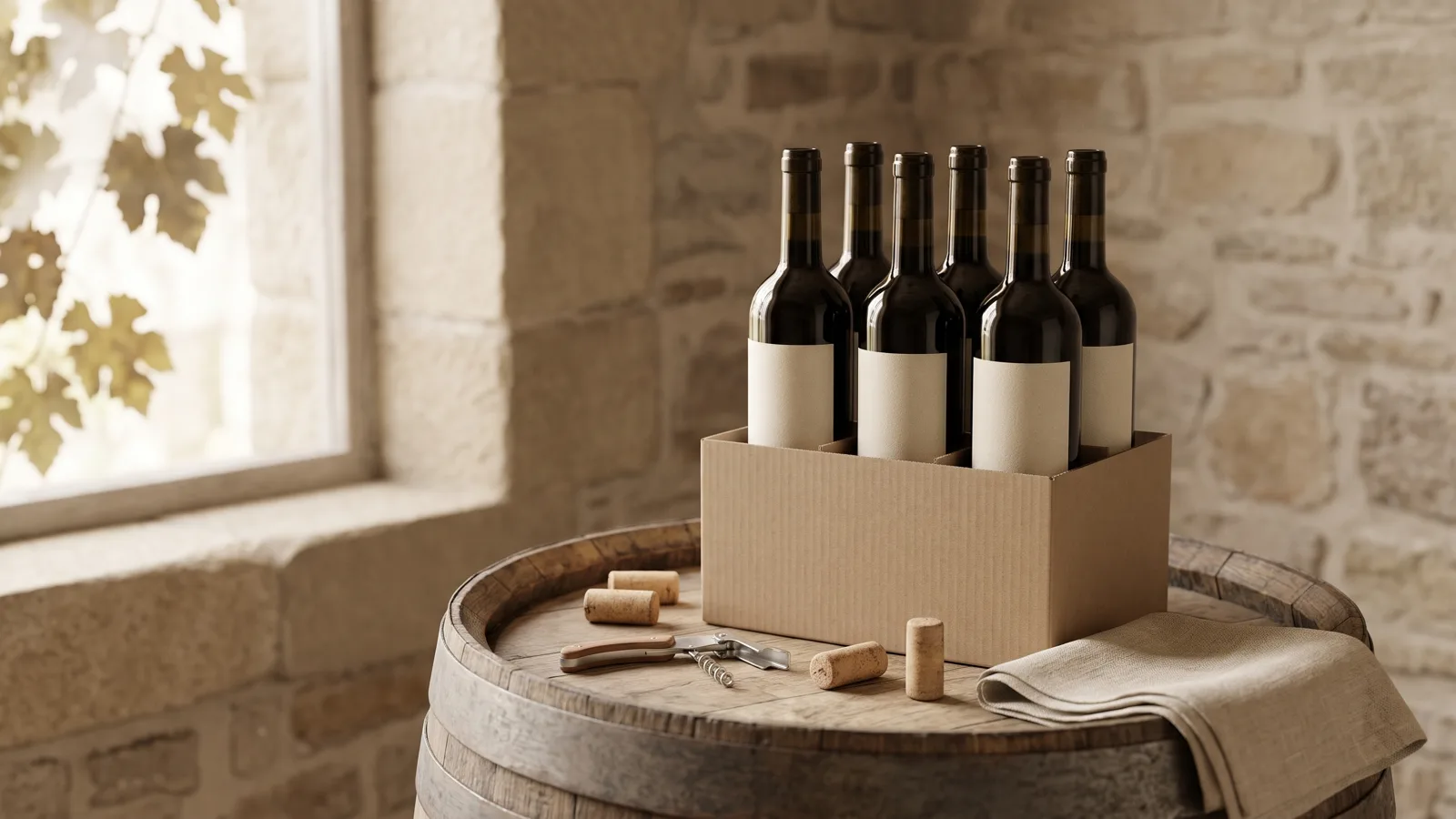
A wine estate, house, cooperative or merchant that bottles wine under its name declares the bottles, closures, labels, cases and shipping boxes that reach households as household packaging, with Citeo, Léko or Adelphe. Bottles served in restaurants usually stay household packaging; outer cartons and pallets that stay with shops and restaurants become professional packaging from 1 January 2027. A producer established outside France that sells to French consumers, for example from its own web shop, acts through a French representative since 10 July 2026.Sources (2) ADEMEADEME — Filière REP Emballages ménagers et papiers (EMPAP)
 LégifranceLégifrance — article L. 541-10-9-1 of the Environmental Code (full text)
This page is for companies that sell wine. If you make the crates, cases or gift boxes, see the packaging makers' page.
| You are | Your page |
|---|---|
| An estate, Champagne house, cooperative or merchant selling wine | EPR and packaging for wine estates and merchants |
| A maker of crates, cases or gift boxes for wine | PPWR for wine and Champagne packaging makers |
Which French EPR streams apply to wine
Wine has no product stream in France: its packaging does. Household packaging covers the packaging of products consumed by households, at home or out of home, and printed paper ADEME. Packaging that ends with businesses falls under professional packaging from 1 January 2027 ADEME.
| What you place on the French market | Stream or rule | Eco-organismes | Who declares | Status | Source |
|---|---|---|---|---|---|
| Bottles, closures, capsules and labels of wine sold in France | Household packaging and printed paper | Citeo, Léko, Adelphe | The estate, house, cooperative or merchant that bottles or has the wine bottled under its name; the importer of bottled wine | In force | ADEME |
| Gift boxes, cases and wooden crates sold with the bottles | Household packaging and printed paper | Citeo, Léko, Adelphe | The same producer as for the bottles | In force | ADEME |
| Shipping boxes and inserts for direct sales to consumers | Household packaging and printed paper | Citeo, Léko, Adelphe | The company that packs and ships | In force | ADEME |
| Bottles served in restaurants and wine bars | Household packaging and printed paper | Citeo, Léko, Adelphe | Usually household packaging, because households consume them out of home ADEME | In force | ADEME |
| Outer cartons, pallets and film that stay with shops, restaurants and wholesalers | Professional packaging (EPRO) | Citeo Pro, Léko Pro, Twiice | The company that packs the goods for the business customer | From 1 January 2027 | ADEME |
| Price lists, brochures and printed cellar-door material | Household packaging and printed paper | Citeo, Léko, Adelphe | The company that issues them, free copies included | In force | ADEME |
| Each packaging type: technical file and EU declaration of conformity | EU Packaging Regulation (PPWR) | — | The packaging manufacturer; for a micro-enterprise estate with an EU supplier, the supplier (Art. 15(12)) | Since 12 August 2026 |  EUR-Lex |
This table as data: JSON · CSV · CC BY 4.0, cite EPR France Rep
Who declares
For packaging, the producer is any business that packs or has its products packed to place them on the market, any importer of packaged products, or, if neither can be identified, whoever first places them on the market ADEME. For wine that means:
- An estate or house bottling under its own name declares the packaging of everything it sells in France, through every channel.
- A merchant (négociant) bottling under its brand declares, even when the wine was bought in bulk.
- A cooperative selling under its own label declares; members who sell under their own label declare their own bottles.
- An estate abroad selling to a French importer: the importer of the packaged wine usually declares. If the same estate also ships to French consumers, from its web shop or a wine club, those bottles are its own to declare, through a French representative.
A worked example: one vintage, three channels
An illustration, not a client: a Burgundy estate sells 30,000 bottles a year in France: 12,000 at the cellar door and online, 10,000 to wine shops and 8,000 to restaurants.
| Channel | What reaches the end user | Stream |
|---|---|---|
| Cellar door and online | Bottle, cork, capsule, label; gift box for some; shipping box and inserts for online orders | Household packaging |
| Wine shops | Bottle, cork, capsule, label; the 6-bottle carton usually stays with the shop | Household packaging for the bottle; professional packaging for the carton from 2027 ADEME |
| Restaurants | Bottle, cork, capsule, label, served at the table; carton and pallet stay behind | Household packaging for the bottle; professional packaging for the carton and pallet from 2027 ADEME |
At 500 g of glass a bottle, the 30,000 bottles are 15 tonnes of glass, and glass is one of the cheapest materials on the household scale: Léko's published scale lists glass at €0.02 per kg, paper and cardboard and wood at €0.255 per kg, plus a per-unit part  Léko. The money is modest; the split by channel, the gift boxes and the online shipping material are where the figures go wrong.
The industry in France, in figures
Wine is thousands of small producers and one heavy material: glass, which makes most of a wine business's packaging tonnage.
| Figure | Value | Year | What it measures | Source |
|---|---|---|---|---|
| Farms specialised in wine growing | 58,100 | 2022 | Agreste farm data, reported by FranceAgriMer | FranceAgriMer: wine key figu |
| French wine exports | over €11bn, -2% | 2024 | Export value, wine only | FranceAgriMer: wine key figu |
| French wine and spirits exports | €14.3bn, -7.9% | 2025 | Export value, FEVS figures reported by Pleinchamp | Pleinchamp, FEVS 2025 export |
| Household packaging placed on the French market | 5.4 million t | 2025 | All household packaging declared to the scheme, all sectors |  Citeo annual report 2025 |
PPWR: what it means for wine packaging
The EU Packaging Regulation (Regulation (EU) 2025/40) has applied since 12 August 2026 EUR-Lex. Points specific to wine:
- Who signs the declaration of conformity. Normally whoever has the packaging made under its name or trademark: the estate, for its branded cases and gift boxes. Where the estate is a micro-enterprise (fewer than 10 people and €2 million or less turnover or balance sheet) and its packaging supplier is in the EU, the supplier is the manufacturer (Art. 15(12)).
- Closures that touch the wine are food-contact packaging, so the PFAS limits of Article 5(5) apply to them.
- Minimisation: wines with a protected designation are exempt from the performance criteria of the minimisation rule (Art. 10(2)(b)).
- Wooden crates: sales packaging of lightweight wood is outside the recyclability requirements of Article 6 (Art. 6(11)(g)); cardboard cases and gift boxes are not.
The French EPR declaration and the PPWR file are two different obligations, often held by two different companies: the estate declares the packaging to its eco-organisme, the crate maker may sign the declaration of conformity. Sources (2)EUR-LexEUR-Lex — Regulation (EU) 2025/40 (PPWR)ADEMEADEME — which producers the EPR schemes cover
Where the work piles up
- Channel split. The same bottle travels through cellar door, shops, restaurants and export; only French sales count, and cartons change stream by channel.
- Gift boxes and seasonal packs. Year-end cases and boxes change every season, with their own weights.
- Online shipping. Boxes, inserts and fillers for direct sales, often from another supplier.
- Exports. Bottles sold abroad are not declared in France, so export volumes have to be taken out reliably.
- Supplier evidence. Glassworks, cork and capsule makers and crate makers each hold a piece of the PPWR file. EUR-Lex
What Managed EPR does for you
With Managed EPR our team does the data work all year and you approve the result. For this industry that means:
- splitting each vintage's French sales by channel and taking exports out;
- keeping a packaging register per format: bottle, closure, capsule, label, gift box, shipping box;
- separating household packaging from the cartons and pallets that become professional packaging in 2027; Sources (2)ADEMEADEME — professional packaging (EPRO) scheme pageADEMEADEME — Filière REP Emballages ménagers et papiers (EMPAP)
- collecting supplier evidence from glassworks, closure makers and crate makers for the PPWR file; EUR-Lex
- preparing each declaration for your approval and keeping the evidence.
Every month we reconcile your French sales and list missing data; every quarter you get a forecast of your eco-contributions; before each declaration you approve the figures, and at year end you get the evidence pack behind each one. You keep your memberships and IDUs if you already have them: we take over from your declaration history under a written mandate.
If you are not established in France
Since 10 July 2026 a producer with no establishment in France must appoint a representative established in France by written mandate (article L. 541-10-9-1 of the Environmental Code) Légifrance. It applies to EU and non-EU companies alike and has no minimum volume. The representative joins the eco-organismes in your name, obtains your IDUs and files your declarations: that is our core service, see what we do.
What it costs
Three ways to work with us, depending on how much of the work you want to hand over.
| Service | What we do | Price |
|---|---|---|
| Representative, Standard | Mandate, membership, IDU and one declaration a year for household packaging and printed paper, up to 1 tonne a year per stream Sources (2)ADEMEADEME — Filière REP Emballages ménagers et papiers (EMPAP)ADEMEADEME — all about the unique identifier (IDU) | €190 a year per stream |
| Representative, Plus or Plus Pro | Up to three streams, up to 10 tonnes a year, with detailed reporting; Plus Pro when you also sell to businesses | €990 a year |
| Managed EPR | We run the data work, with a median saving of €1,071 a year in eco-contributions across our published clothing, footwear, electronics and furniture examples: monthly sales reconciliation, supplier follow-up, quarterly forecast, every declaration prepared for your approval, year-end evidence pack Sources (2)ADEMEADEME — Filière REP Textiles, linge, chaussures (TLC)ADEMEADEME — Filière REP Éléments d'ameublement (EA) | On quote, after a look at your data |
| PPWR | Readiness check of up to 25 packaging items; declaration of conformity and technical file per packaging type | €390 per company; €149 per type reviewed, €290 prepared by us |
Setup is €0. Eco-contributions are billed by the eco-organisme at its official rate and passed on with 0% markup. See pricing, Managed EPR and the PPWR readiness check. Sources (2)EUR-LexEUR-Lex — Regulation (EU) 2025/40 (PPWR)ADEMEADEME — which producers the EPR schemes cover
Frequently asked questions
Are bottles sold to restaurants household or professional packaging?
Usually household packaging: households consume the wine out of home, and household packaging covers consumption at home or out of home. The cartons and pallets that stay with the restaurant become professional packaging from 1 January 2027. Sources (2)ADEMEADEME — professional packaging (EPRO) scheme pageADEMEADEME — Filière REP Emballages ménagers et papiers (EMPAP)
We sell to a French importer. Do we declare?
The importer of the packaged wine usually declares it. Bottles you ship directly to French consumers are yours to declare.
Our crate maker asks whether we are a micro-enterprise. Why?
Under Article 15(12) of the PPWR, when the brand owner is a micro-enterprise and its packaging supplier is in the EU, the supplier draws up and signs the declaration of conformity. See the packaging makers' page. EUR-Lex
Do we declare exported bottles?
No. French EPR covers what is placed on the French market. Exported bottles are left out, which is why the channel split matters.
Citeo, Léko or Adelphe?
All three are approved for household packaging. We compare them on your materials and volumes. ADEME
Can you take over from our current representative or consultant?
Yes. You keep your membership and IDU; we take over under a written mandate and file your next declarations. ADEME

Razvan Toma is the founder of EPR France Rep, a France-established authorised representative (mandataire) for producers with no French establishment. He has worked in waste management and recycling since 2009, running circular economy programmes inside large B2B organisations in France for clients including Chanel, Microsoft, Decathlon, Pirelli, IKEA, Vinci, Capgemini and E.Leclerc.
Connect on LinkedIn →